
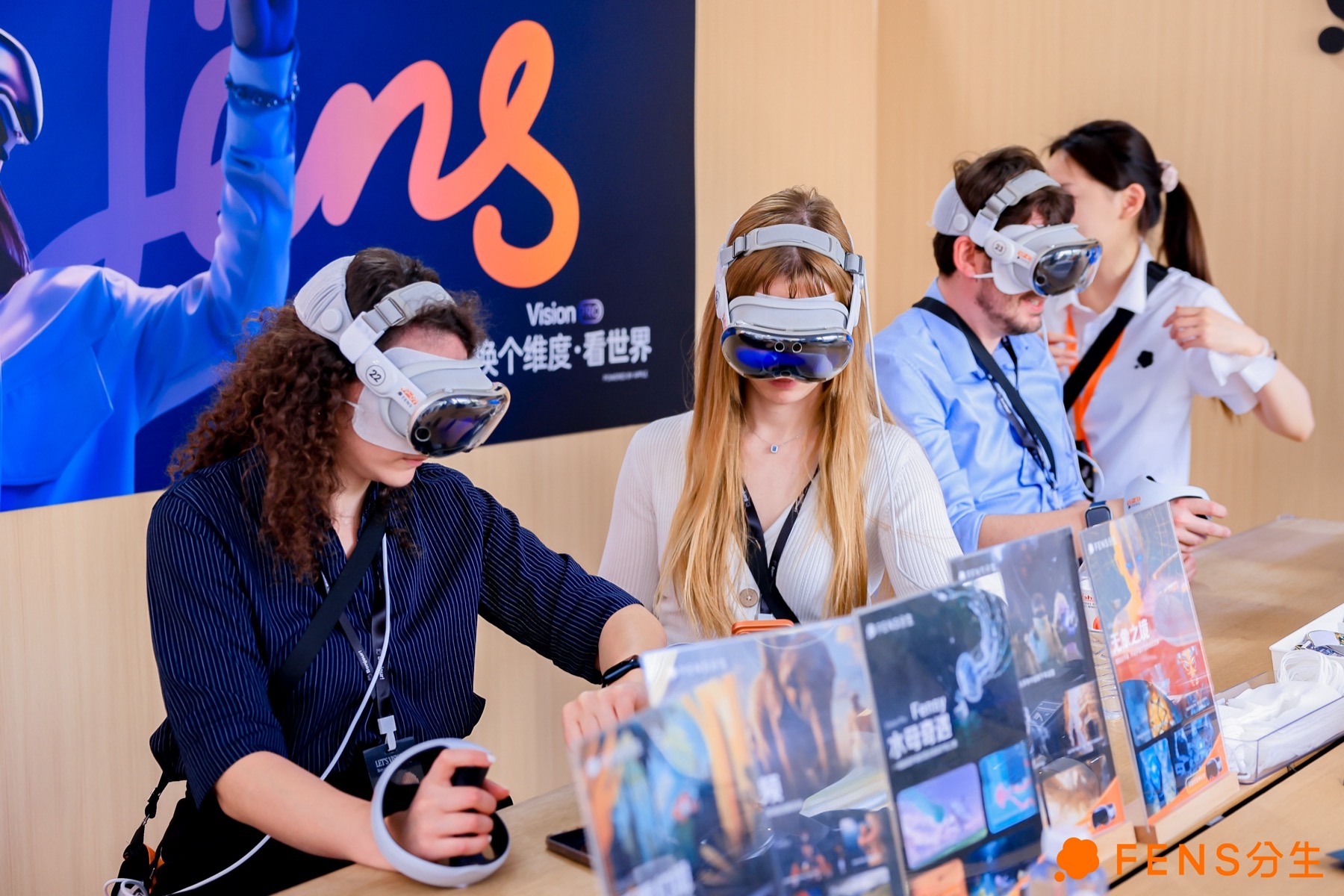
The Studio Meije team just got back from Let's Vision 2026, and with Apple turning 50 today, we feel like it's the right moment to lay out why we're betting on Vision Pro for enterprises.
Back in 2024, when Vision Pro launched in France, we thought:
"It's the perfect opportunity for a very small team to iterate on spatial computing and find their niche."
Back then we couldn't see the full picture, but we suspected early on that Vision Pro could work well for enterprises.
That small team became Studio Meije, and despite the constant negative headlines from the mainstream media we believe that Apple has long-term plans for both the Vision product line and their business offering.
In 2026, the signals are now visible. These are the ones we want to share.
Vision Pro M5
The original Vision Pro shipped in 2024 with the M2 chip. Combined with the R1 chip, it was the most powerful mainstream standalone headset available. Nonetheless developers and customers with demanding workflows still found its limits.
In fall 2025, Apple released the M5 chip on MacBook Pro and Vision Pro at the same time, enabling more complex workflows on the device. This was the top request from enterprise customers, and the companies we work with are now deploying with confidence.
Apple is heavily investing in Vision talent
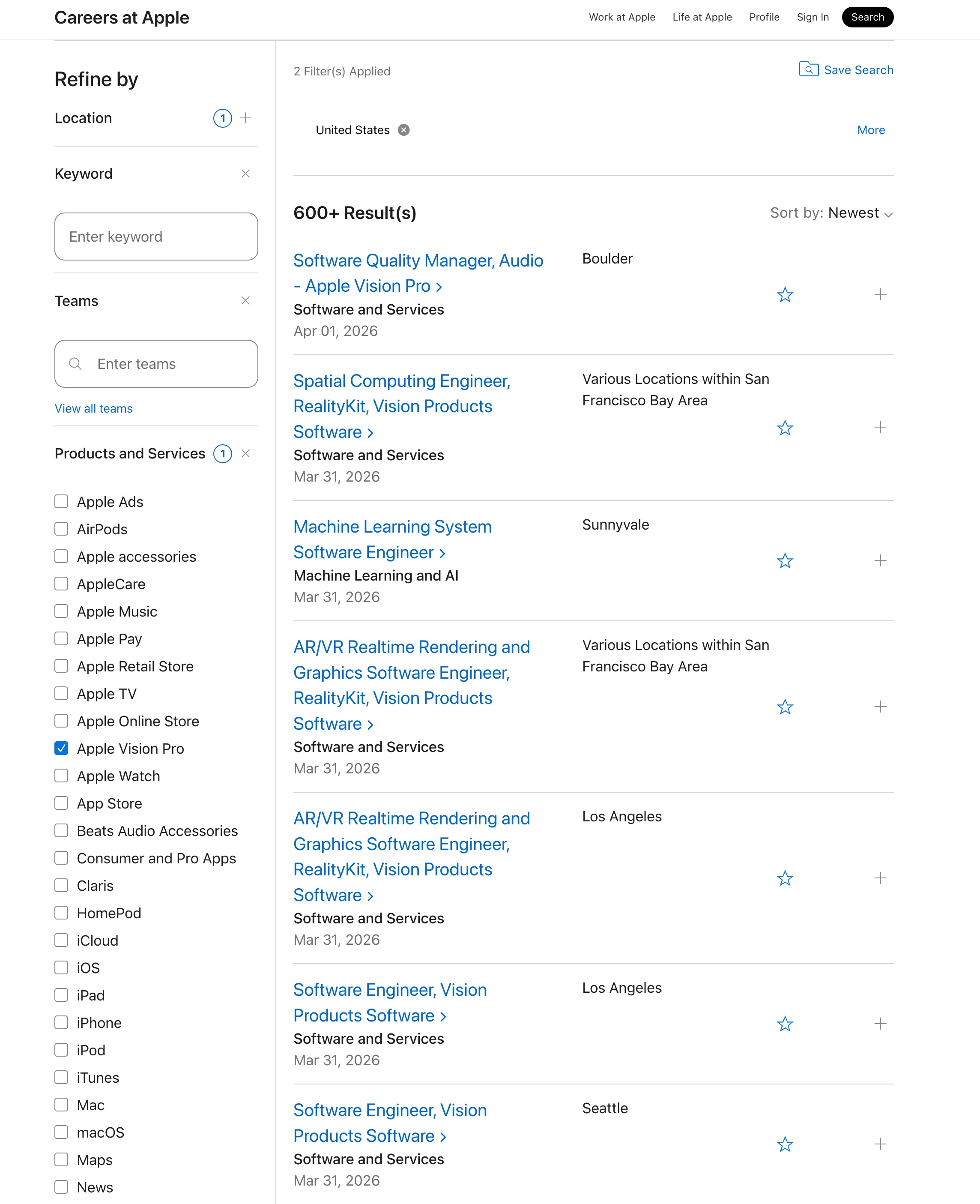
We wanted to back our intuition with data, so we scraped Apple's job board filtered for the Vision Pro product tag. The results: over 600 listings across 37 pages. After deduplication (Apple posts the same role in multiple cities), that's around 365 unique job titles, roughly 61 of them tied to visionOS or Vision Pro by name.
Those 61 roles cover the full stack. The Vision Products Software org has around 35 open positions: RealityKit rendering engineers, FaceTime on visionOS, spatial platform engineers, UI frameworks, streaming, audio, and AR/VR engineers working on Personas and Photos. On the hardware side, 9 roles name Vision Pro: optical engineers, hardware system engineers, product design engineers. Machine learning has visionOS-specific positions too.
The broader picture is just as telling. Beyond the dedicated roles, around 300 shared Apple platform positions list Vision Pro as a relevant product. 55 ML and AI listings. 19 camera and imaging roles feeding into spatial video and personas. A substantial hardware engineering presence across silicon design, thermal, and systems engineering.
The number that stopped us: over 40 sales and business development roles tagged with Vision Pro. Enterprise partner development executives. Channel strategy positions. Apple is building the commercial infrastructure to sell Vision Pro into businesses. Job listings are a more reliable signal than press releases, and 365 unique positions don't appear by accident.
CloudXR and Foveated Streaming: a game changer for enterprise use cases
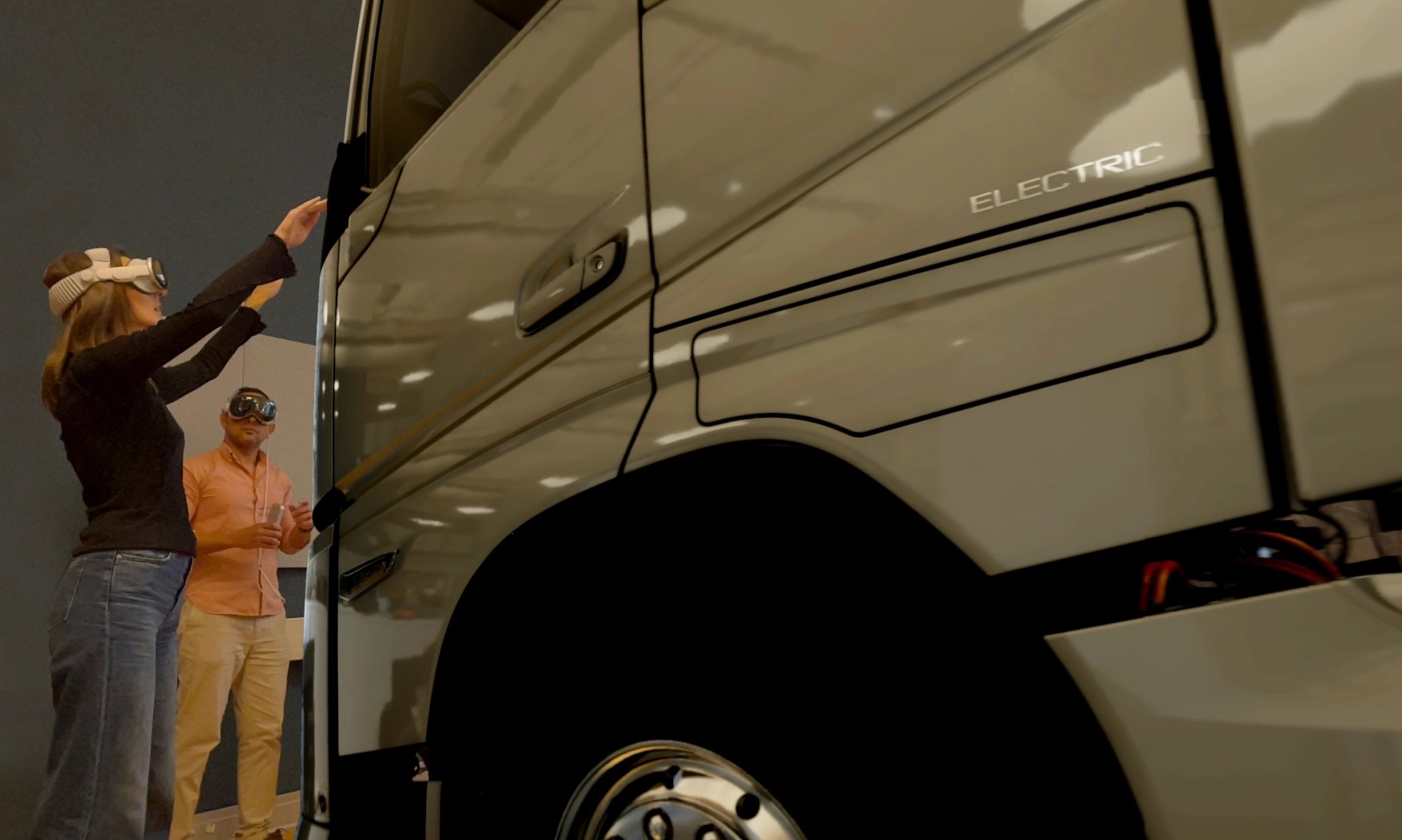
With visionOS 26.4, Apple introduced a first-party Foveated Streaming framework that works directly with NVIDIA CloudXR 6.0. In practice: you can wirelessly stream full 4K RTX-rendered content to the Vision Pro from a remote workstation or cloud server.
The system uses Vision Pro's eye-tracking to detect where you're looking and pushes full resolution only in that area, reducing detail in your peripheral vision. You don't notice the difference, but the bandwidth savings and GPU cost reduction on the server side are significant. Your gaze data is never exposed to the application, which fits Apple's privacy-first approach.
Until now, showing a complex 3D model on the Vision Pro meant simplifying it to run locally on the device. That was a real constraint. Now, an architect can walk through a full-scale building, a car designer can review a vehicle at real-world proportions with ray-traced materials, a factory engineer can inspect a digital twin of a production line. All wirelessly, at full fidelity.
This isn't theoretical. BMW Group, Kia, Rivian, and Volvo Group are already using CloudXR with Autodesk VRED for collaborative design reviews across global teams. Foxconn is visualizing factory walkthroughs. Roche is simulating biofluid analysis labs. These are the high-value, specialized use cases where Vision Pro makes sense in a business context.
Gaussian Splatting is now part of the OpenUSD standard
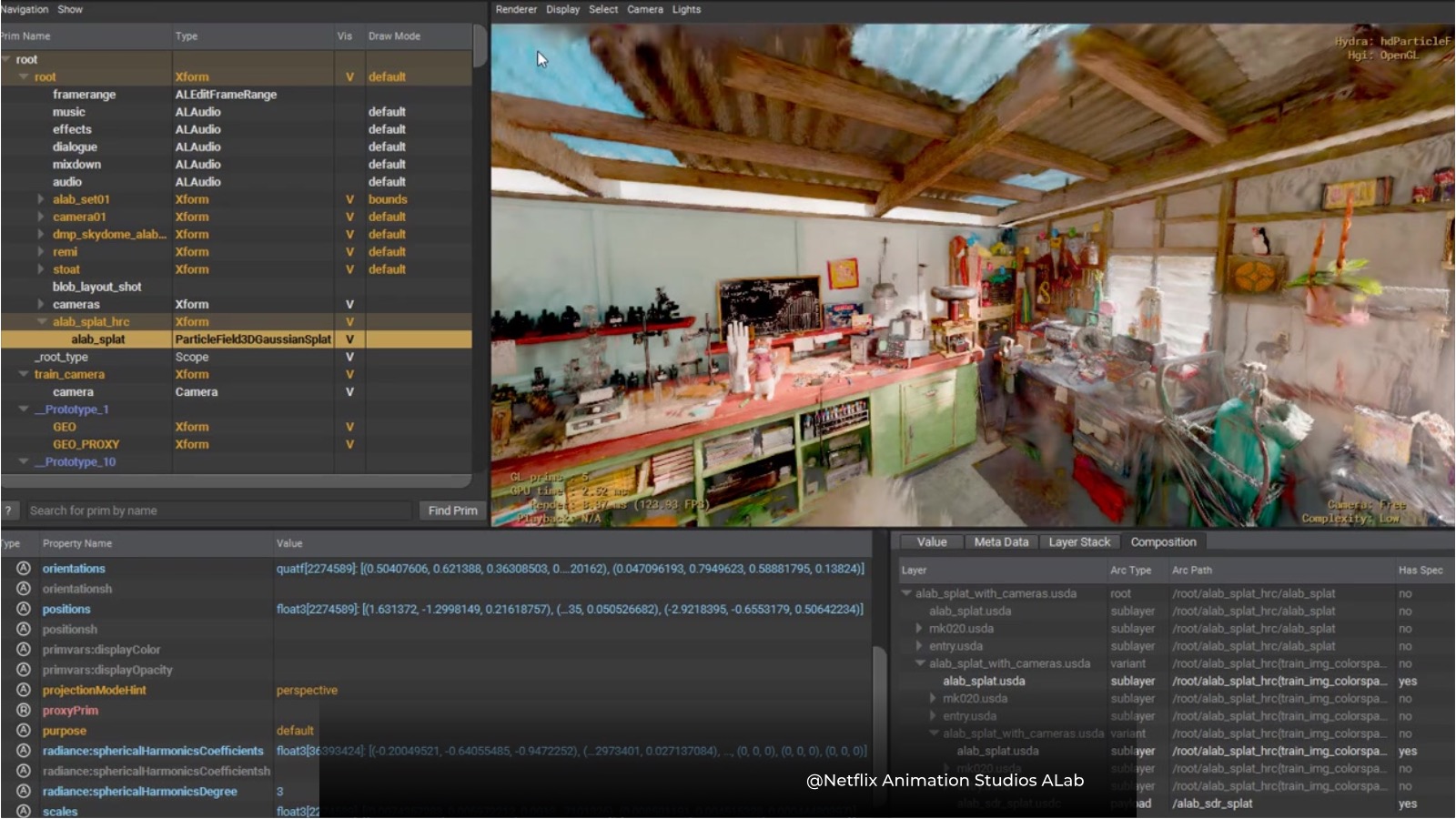
Gaussian Splatting captures real-world environments and objects as photorealistic 3D scenes, faster and more easily than traditional photogrammetry. OpenUSD v26.03, released in March 2026, introduced a new schema for 3D Gaussian Splats. With it standardized in OpenUSD, these assets can move through the same pipelines enterprises already use for their 3D content.
For Vision Pro, this opens concrete possibilities. A construction company can capture a job site with a simple scan and review it in spatial context on the headset. A real estate firm can offer immersive property walkthroughs without modeling anything by hand. Apple is a founding member of the Alliance for OpenUSD, so RealityKit support for the new Gaussian Splatting schema is likely coming, we suspect in visionOS 27. When it does, it removes another barrier between enterprises and spatial computing workflows on Vision Pro.
Apple is launching Apple Business on April 14
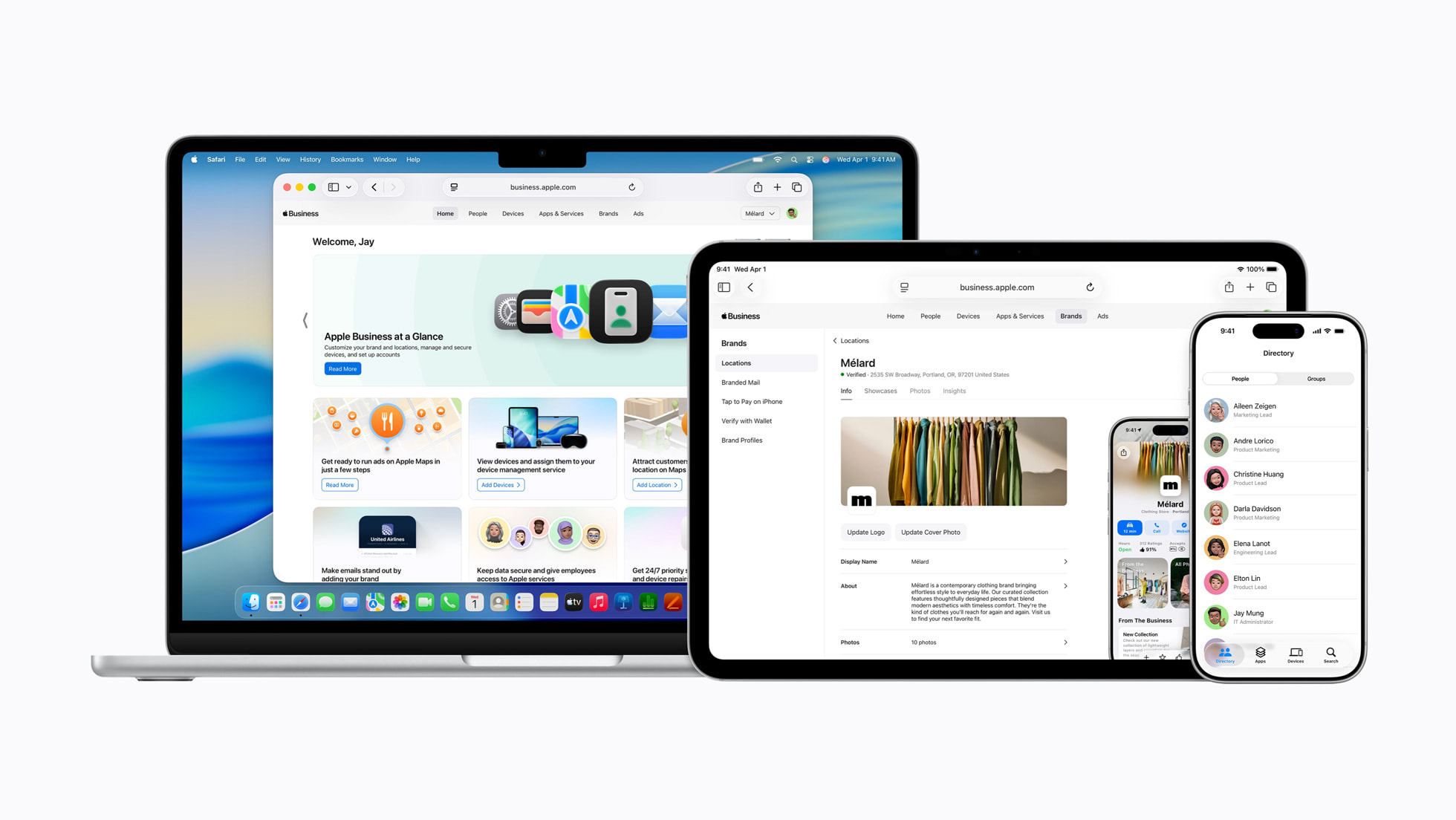
Apple announced Apple Business, a platform that merges Apple Business Connect, Essentials, and Manager into a single free service available in over 200 countries.
It comes with built-in MDM and a new feature called Blueprints: preconfigured device setups that enable zero-touch deployment. An IT team can prepare a fleet of Vision Pro headsets, pre-install the right apps, configure everything, and hand them to employees ready to go. No manual setup per device. It also supports managed Apple Accounts with proper separation between work and personal data, automatic account creation through identity providers like Google Workspace or Microsoft Entra ID, and an Admin API for large-scale deployments. Teams get the apps they need for their role, pushed directly from the platform.
Apple is removing one of the biggest friction points for enterprise Vision Pro adoption.
Enterprises are open to the Vision Pro as a good solution for selected use cases
Something is shifting in the enterprise XR space that works in Apple's favor. Microsoft is ending HoloLens support in 2027. Magic Leap has cycled through multiple pivots without a sustainable business model. Many enterprises stay cautious about Meta when sensitive company and employee data are involved. For organizations that built mixed reality workflows, the range of trusted options is shrinking.
Vision Pro won't cover every use case once handled by HoloLens or Magic Leap, particularly hands-free industrial AR on the factory floor or outdoor operations. But for training, simulation, design review, remote collaboration, 3D visualization, and digital twins, it's proving to be a strong fit. Companies are no longer looking for one device that does everything. They want the right device for the right use case.
Vision Pro stands out for its visual quality, deployment simplicity, and the confidence Apple provides on privacy, security, and long-term platform support. Companies that were hesitant a year ago are now actively exploring it. The alternatives are fading, and Apple is building real enterprise infrastructure.
We are also working with customers who use Vision Pro as the software platform that will help them be ready for when Apple releases a see-through device.
This is why we chose to focus on it at Studio Meije. We're building an immersive suite for Vision Pro to help enterprises move from isolated demos to real operational workflows, in training, visualization, and collaboration.
If you're exploring Apple Vision Pro for enterprise use cases, reach out.