
This blog post was originally posted on Tab To Tap's website, Tom Krikorian's company that has since merged with Studio Meije.
I felt it was time to write about the state of the ecosystem in light of the recent news. My feed has been filled with articles announcing the end of the Vision Pro:
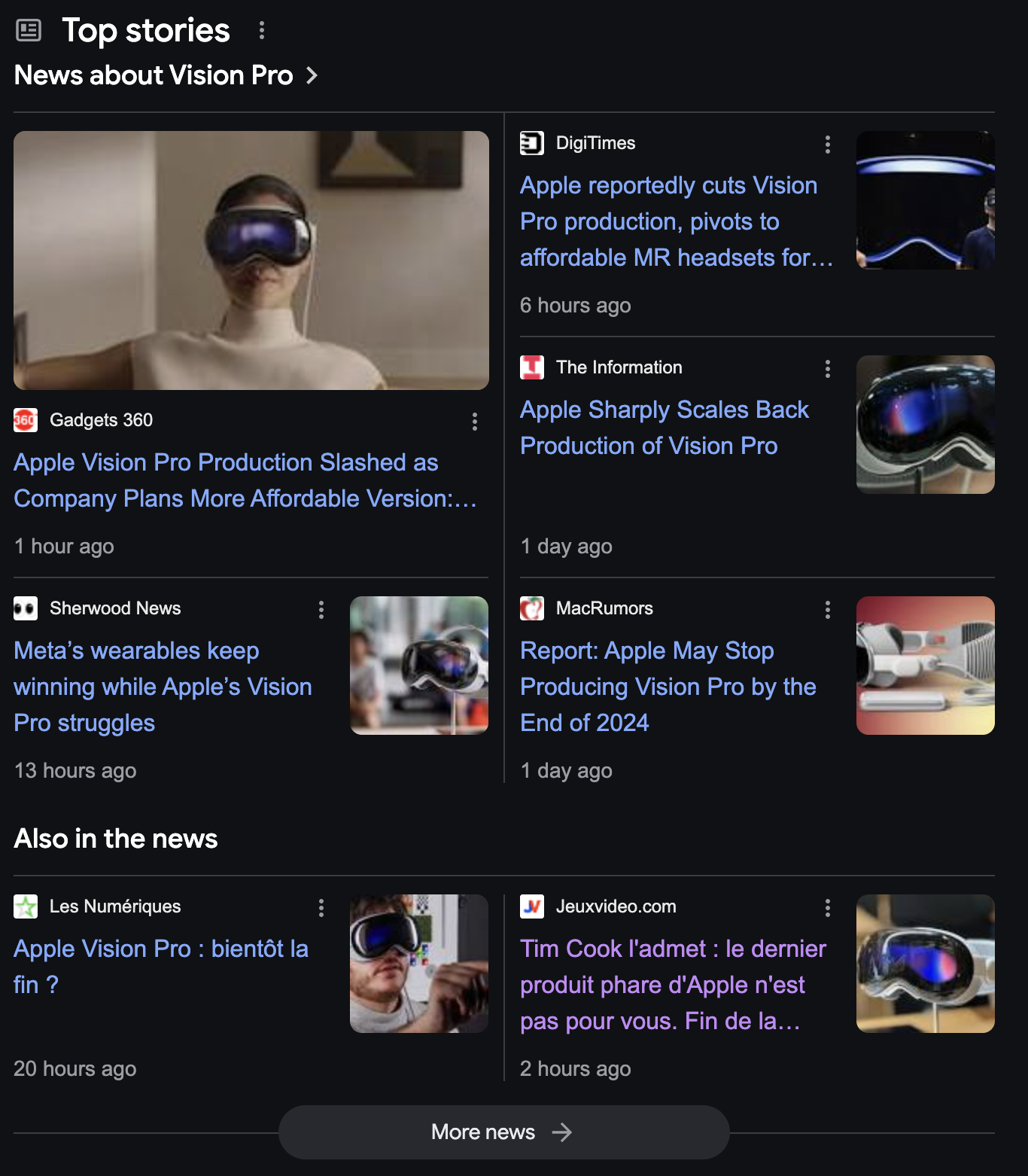
All these headlines are quite alarming, right? So what's behind these clickbait titles?
Before we dive in, if there's one article to read about the Vision Pro production being halted, it's this one from UploadVR:
Apple Could Reportedly Stop Vision Pro Production By The End Of The Year
They have consistently proven to be a reliable source for news about the XR ecosystem, and I highly recommend them.
It's easy to criticize the Vision Pro and for good reasons. The launch of this device was clearly not the moment we had all been anticipating for years. However, the press has been repeating the same arguments for months, claiming it's not selling well and citing the same analyst who has been debunked several times regarding the number of units produced, while ignoring a significant part of what's happening.
We have known for a long time that the number of units produced this year would be around 600,000. Considering the known hardware issues and the release of the next Vision Pro coming next year, it makes sense to stop the production of the current generation.
Now that we've covered that, let's discuss the current state of the Vision Pro, what's happening now, and what I hope will happen in the next few years.
Chicken or the egg
I think we can all agree that we're at a weird moment with the Vision Pro. A common argument about where it falls short is the lack of things to do on the device, and I fully agree with this. Personally, I've been using my Vision Pro mainly to watch immersive content, and since I've pretty much watched everything available, I'm now only using it to develop my apps.
I decided to check the data available on AppFigures myself and found this information about the release of visionOS native apps:
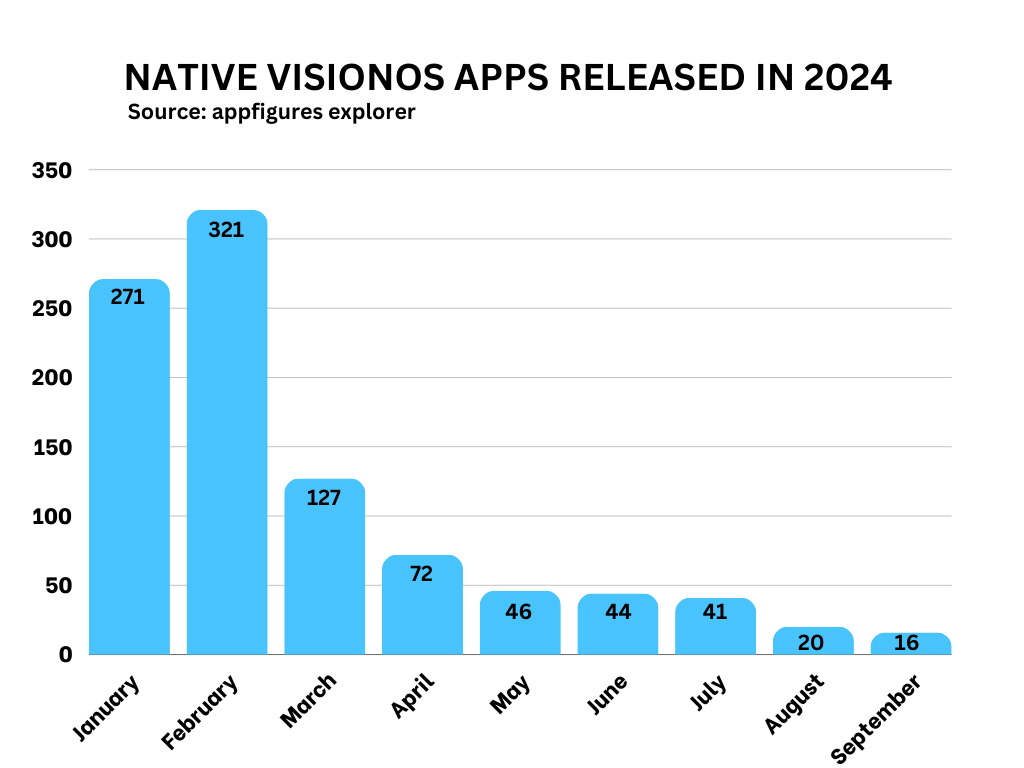
Some developers quickly embraced the platform and released most of the apps available today around the time the device launched. Among these apps, many were just trying to capitalize on the low-hanging fruit or make very simple apps to learn visionOS development and have a small portfolio, thinking it would work like iOS.
Expectations were high, but reality set in quickly: you can't be profitable selling B2C apps on the App Store with the Vision Pro. I saw many developers saying they managed to reimburse their Vision Pro, but that's pretty much it. Most developers I know did not make enough money on the platform to justify investing more time in it. I'm still waiting for data that proves me wrong, but it's not publicly available.
It's also important to note that creating immersive content or apps that fully utilize the VR or MR features of the headset takes time. As developers, we are still figuring things out with visionOS. The technology is still new, with RealityKit lacking many essential features. Unity Polyspatial received really useful updates after launch. Some hardware (like Blackmagic Cine Immersive) and software updates (such as DaVinci Resolve Immersive Features) are not yet available to support the production of 180° immersive content with the same quality that Apple has been producing.
I'm in the camp that think the Vision Pro should have been marketed like this since the beginning to avoid all the bad press we're getting today. Still, I'm glad Apple entered the race and as I wrote in a previous article, they have a place in the ecosystem and cards to play.
What now?
The Vision Pro is here to stay, we're getting a new and cheaper version next year and they're aiming for a few million units apparently. Apple is also working on the Vision Pro 2 and a Meta Ray-ban competitor. So clearly they're committed to the space.
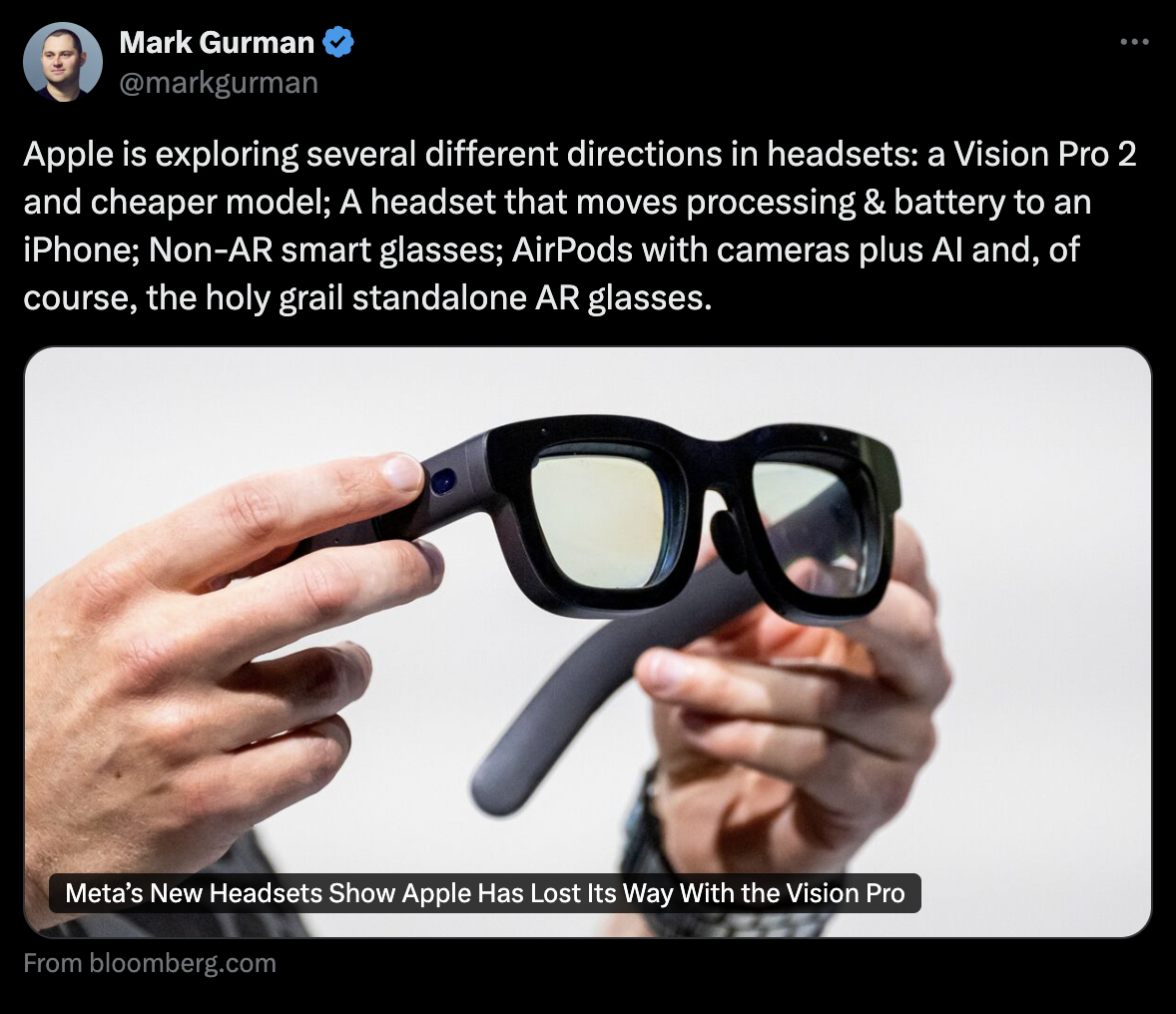
I'm not saying Apple has been successful with this launch; quite the opposite. However, they've been listening to feedback and are adjusting their approach. Now, we're all waiting to see if they truly understood the feedback they received and if it will be reflected in the new device and their overall strategy.
I'm quite confident that visionOS will become a great ecosystem in the future. My main concern is how long it will take to get there. If the next device doesn't address core issues like comfort and pricing, we might have to wait for the 3rd or 4th generation. Early adopters like myself might look for other platforms where we have a better chance to be profitable or get funding. It would be unfortunate for Apple to lose the developers who started the ecosystem because they couldn't support them properly at the beginning.
Learning from past mistakes
One thing we've learned as an industry in recent years is that trying to solve a non-existent problem with VR is pointless. Also, assuming VR is the right solution for certain problems can lead to a dead end. I believe many newcomers from iOS development don't consider this while creating apps for the Vision Pro. Sometimes, VR should just be a feature, not the product itself.
I'm not saying you can't explore ideas that don't seem to solve anything at first glance, but be aware that, in my experience, VR development takes longer than mobile development. You might end up spending more time on the wrong idea in this space and burn yourself.
What's next?
The end of 2024 and 2025 will be crucial for the visionOS ecosystem and for many developers focused on the platform. I'll try to follow my own advice during this period and hope we see more positive developments in the coming weeks and months!
I've been observing the space since its launch, waiting for the right idea that fits the Vision Pro and my background. I'm currently working full-time on a prototyping app called Page Blanche (more about this app will be shared soon on my blog and social networks).
While this app will be available on the App Store, I view it as a showcase of what a good collaborative design tool should be on the Vision Pro. My main focus will be on finding B2B use cases where Page Blanche can be genuinely useful and where VR is practical. Although I'm not ruling out earning revenue from the B2C app, I'm keeping my expectations low.